
Right then. It’s dark by half four, the hives are quiet, and the bee news has been piling up on me. The big story this week comes from Poland, and it’s a reminder that the Asian hornet isn’t sitting still. There’s also a review asking awkward questions about how pesticides get tested, varroa turning up somewhere it’s never been, and a couple of studies on heat and on moving hives about.
Poland’s first Asian hornet nest held about a thousand workers
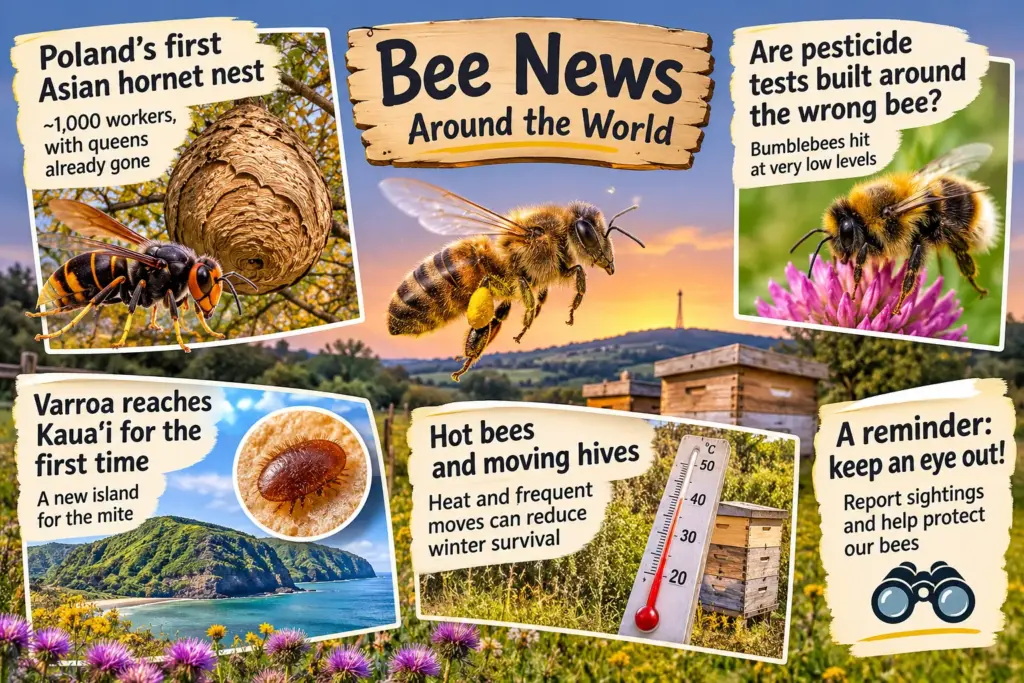
Poland has found and removed its first confirmed Asian hornet nest. According to a report on The Cool Down, it was spotted in mid-October high up in a tree in the village of Wielka Wieś. Once it was down, it went to scientists at Wrocław University of Environmental and Life Sciences, who counted around 1,000 workers inside, plus several dozen queens and males.
The bit that bothers me is what else they found. There were still eggs and larvae, so the colony was alive and feeding right up to the end. And some young queens had already left. Those queens can see the winter out and start new nests in spring, so taking one nest down doesn’t mean the job’s finished. Paweł Migdał from the university described it as fairly large for Poland’s climate.
This hornet first got into Europe through France in 2004 and it’s been spreading ever since. If it can build a nest that size in Poland, I wouldn’t count on our Yorkshire weather keeping it out. If you think you’ve seen one here, report it through the Asian Hornet Watch app. A photo helps a lot.
Are pesticide tests built around the wrong bee?
A systematic review in the journal Frontiers in Bee Science, written up on Bioengineer.org, pulled together 124 studies from 2017 to 2026 on how systemic insecticides affect bumblebees. It looked at the older neonicotinoids, imidacloprid and clothianidin, and at newer chemicals such as sulfoxaflor and flupyradifurone.
Exposure as low as 5 to 10 parts per billion often caused sublethal harm. Less brood, fewer new queens, smaller colonies. Those concentrations often sit within or below the legal limits for many of the newer insecticides.
What struck me most was the point about testing. Risk assessments have long used the honey bee as a stand-in for every bee species. But a honey bee colony is massive and well buffered. A bumblebee colony is small, lasts a single year and starts with one queen, so it can’t take the same knocks. I’m a honey bee man through and through, but I don’t like our bees being the yardstick for creatures that are far more fragile. One caveat. Around 84% of the studies were done in the lab, and the headline’s talk of colony collapse goes further than the review itself, which mostly describes sublethal effects.
Varroa reaches Kauaʻi for the first time
Over in Hawaiʻi, varroa has been confirmed on Kauaʻi for the first time, reports Kauai Now. A feral colony found on 9 November turned out to be carrying mites, though at a low infestation level. A local beekeeper destroyed the colony straight away, and samples went to the University of Hawaiʻi at Mānoa and the state’s agriculture department.
Varroa was first picked up on Oʻahu in 2007 and is also established on Hawaiʻi Island, so Kauaʻi was one of the places still holding out. Officials are now checking whether it has spread to other colonies, and local bee educators are urging people not to bring bees in from other islands. Alan Spencer, a bee educator at Kauaʻi Community College, said: “This has been a big fear for Kauaʻi beekeepers for a long time.”
We’ve had varroa in Britain for so long that it’s easy to forget what it means to lose a mite-free area. Those beekeepers are about to learn a whole new routine, and I don’t envy them. It’s the same lesson we keep hearing with the hornet. Move bees about and you move their problems with them.
Hot bees and the value of pollen
Researchers at Washington State University have published a lab study in Scientific Reports on what heat does to honey bees. They kept caged groups of newly emerged workers for 14 days under three set-ups: a steady 33°C, a cycle of 40°C by day and 33°C by night, and a heat shock group that was switched suddenly onto that hot cycle halfway through. Some groups got pollen patties and some didn’t.
The bees that had the sudden shock with no pollen died at the highest rate. Their gut bacteria held up better than you might expect, with just one type, Bombella intestini, clearly dropping under heat stress, and the authors found no strong effect on the bees’ proteins. It’s a cage study in an incubator rather than a hive, so I wouldn’t read too much into it. Still, it fits with what most of us would guess. A sudden shock is harder on bees than a steady stress, and decent pollen seems to help.
Moving hives and winter survival
Another paper in Scientific Reports, from Nectar Technologies in Montréal and Washington State University, used records from 362,884 colonies belonging to 62 beekeepers over four years. They used machine learning to see how often colonies were moved and how that lined up with survival.
Colonies that were moved more often were less likely to survive beyond one season, and longer gaps between moves went with longer predicted lives. The authors are clear that this is an association rather than proof of cause, because weather, colony health and forage weren’t fully measured. Two of the authors also work for Nectar Technologies, which is worth knowing.
This is big migratory beekeeping, which isn’t how most of us keep bees here. But if you take colonies to the heather or shift them around for crops, it’s a fair prompt to ask whether every move is earning its keep.
That’s me for this week. If you fancy seeing bees up close once they’re flying again, we run 90-minute beekeeping experience sessions at the apiary, and the dates are on the website. Until next week, keep your hive entrances clear and your hefting arm in shape.