
If you’ve ever wandered out into the garden and found a football-sized clump of bees hanging off a branch, you’ll know the feeling. Half fascination, half “what on earth do I do now.” It’s exactly how I got into this whole thing. A swarm landed in our field, a beekeeper came out to collect it, and by the end of the year I’d signed myself up for a beginners’ course. So if you’ve spotted one, take it as a good sign. It usually means something interesting is about to happen, not a disaster.
Why swarms happen
A swarm isn’t bees attacking, escaping, or angry about anything in particular. It’s a colony splitting in two. When a hive gets crowded, usually in late spring or early summer, the old queen leaves with roughly half the workers to find a new home, while the bees left behind raise a new queen of their own. It’s how honeybee colonies reproduce. Nature’s way of saying the hive’s doing well enough to start another one.
Swarming season in South Yorkshire tends to run from May through to early August, with a real peak in June. If you’re seeing one now, you’re right in the thick of it, not late to the party.
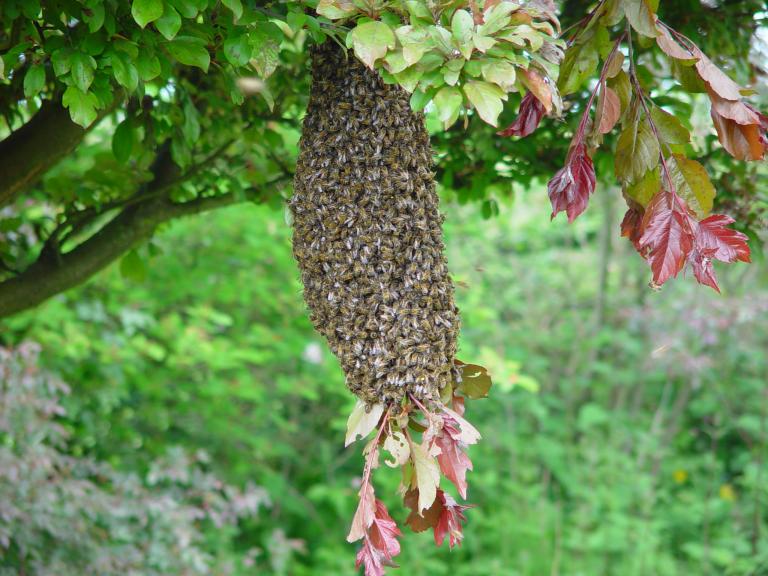
What it actually looks like
A settled swarm is usually a dense cluster of bees hanging from a branch, fence post, or wall, sometimes the size of a rugby ball, sometimes bigger. They can look alarming, but a swarm in this resting state is generally calm. They’ve got no hive to defend yet, no honey stores, nothing to protect. Most of the aggression people worry about with bees comes from defending a home, and at this stage, they don’t have one.
What you don’t want to do is spray them, disturb them, or try to move them yourself. Leave them be and get in touch with a local beekeeper instead.
Your paragraph text goes here, right after the iframe in the HTML. It’ll wrap around the right-hand side of the video automatically once the float is applied.
What to do if you spot one
Give us a call or drop us a message through the Swarm Help page, and try to have a rough idea of these before you call:
Where the swarm is (a fence, a tree, the side of a shed), roughly how high up it is, and how long it’s been there. A photo helps enormously if you can get one safely from a distance. We’ll usually come out and collect it, giving the bees a proper new home in one of our hives rather than leaving them to fend for themselves or, worse, having someone deal with them the wrong way.
If it’s sparked your interest
Swarms have a funny way of pulling people into beekeeping who never thought they would be. That’s genuinely how this all started for me. If watching a colony up close has got you curious rather than nervous, our Beekeeping Experience is exactly the next step, a proper hands-on morning in the apiary, no experience needed.