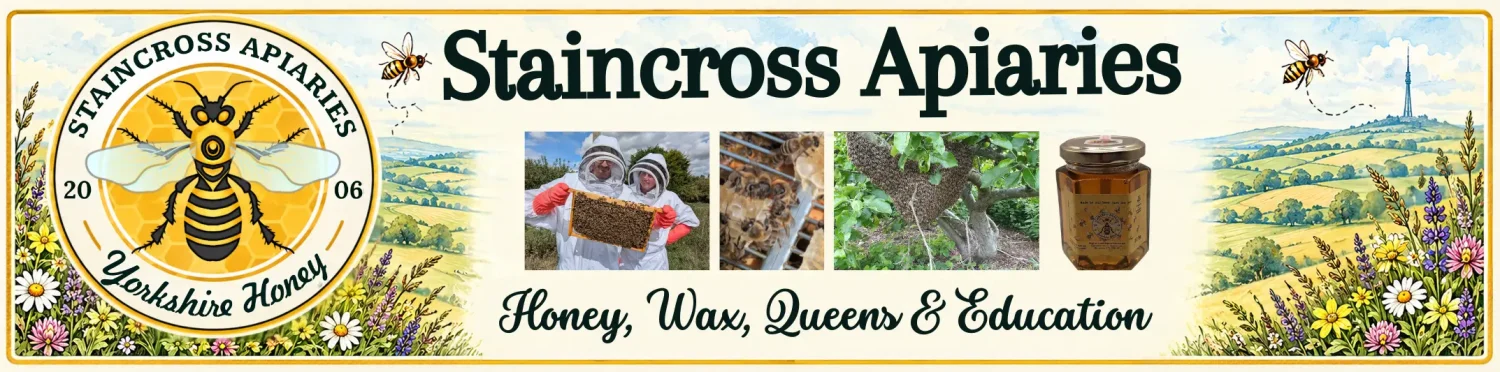
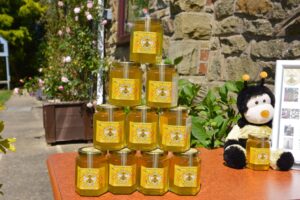
 At Staincross Apiaries, our Yorkshire honey is meticulously extracted to preserve its natural purity. We refrain from flash heating during processing, ensuring the honey retains its original state. We only use coarse straining to keep beneficial pollen particles, removing wax yet sometimes imparting a cloudy appearance. We believe less filtering conserves more flavour. Our chunk honey features a piece of the original wax comb, surrounded by strained honey, offering a taste as authentic as nature intended.
“Raw” Honey?
When people say raw honey, they usually mean honey that hasn’t been heated or ultra-filtered, only strained enough to take out the bits of wax. That’s how we treat ours, but it isn’t a word we can put on the jar.
The catch is that “raw” isn’t a permitted description on honey for sale in the UK, so you won’t see it on our jars. If a jar does say raw, it doesn’t tell you for certain how the honey was handled. A beekeeper’s name and address on the jar tells you more than the word does. If you want honey in its most natural state, buy it in the comb with the wax cappings still on. Read more about raw honey in the UK
“Organic”?
The European honey bee’s typical foraging range is up to about 3 miles, which presents a challenge for certifying honey as organic in the UK. Given the proximity of organic to non-organic farmland, achieving pure organic foraging is extremely difficult. Consequently, most “organic” honey in the UK is imported, mainly from countries like Brazil and New Zealand. It’s advised to inquire about the origins and certification of “organic” honey when purchasing in the UK, due to these stringent criteria and the prevalence of imported products.
“blend of EU honeys”?
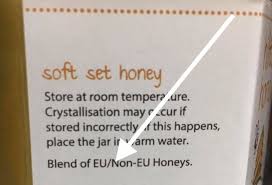 Most supermarket honey in Europe, over half, is imported from China and often undergoes ultra-filtration, removing pollen and making it difficult to verify its origin. In 2016, the European Commission found that 20% of imported honey was adulterated with added sugars to increase volume. This highlights the value of paying a premium for honey from local beekeepers, ensuring authenticity and supporting sustainable practices. You can read more about Honey Adulteration here.
Crystallisation
Crystallisation is a natural process that occurs in high-quality honey over time, signifying its purity. To return crystallised honey to its liquid state, simply loosen the jar’s lid and warm it gently in a bowl of warm water. This method preserves the honey’s quality while restoring its smooth consistency. Read more about soft set honey